

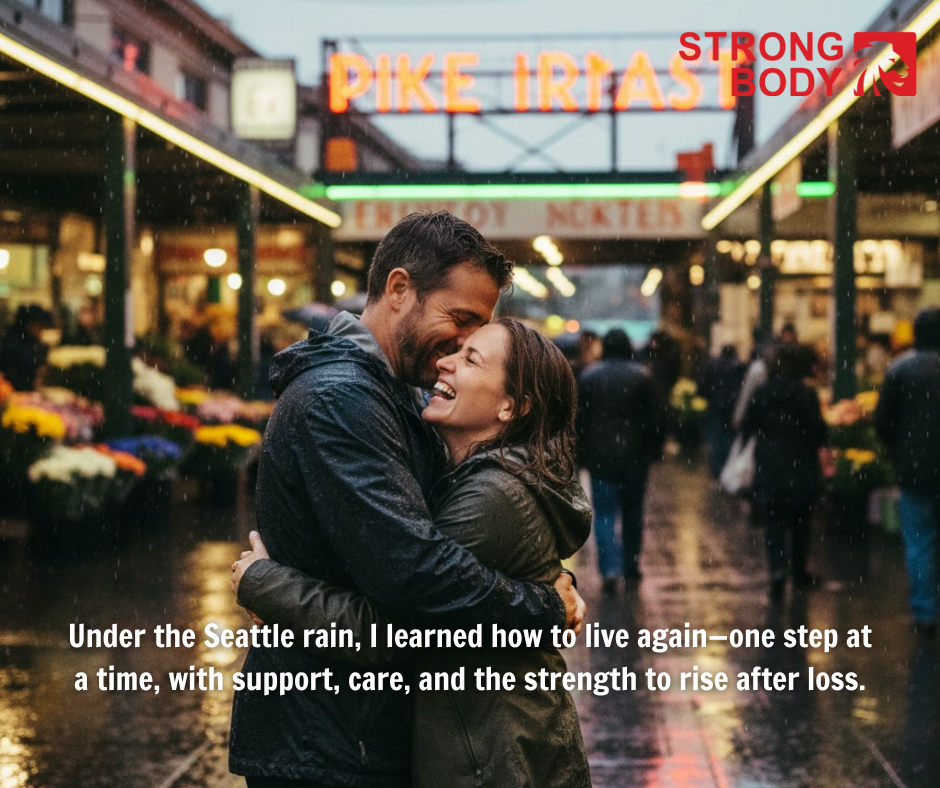
The 17th-floor apartment in an old Capitol Hill building, Seattle, was lit only by a single 40-watt desk lamp casting a faint, sickly yellow glow through the thick night rain. November 2025. Outside, the city still sparkled with the lights of Amazon and Microsoft towers, but inside these four walls everything was gray and heavy. Sarah Elizabeth Thompson, 45, a literature teacher at Roosevelt High, sat curled up on the worn brown leather sofa, a thin wool blanket wrapped around her like an old cocoon. The smell of morning coffee, now cold, still hung in the air; a cup of herbal tea had sat untouched for three days. The window was fogged with condensation, rain hammering the glass like thousands of fingers begging to be let in. Sarah sighed—a deep, weary sound that echoed in the absolute silence. Three and a half years had passed since her husband David was killed on Interstate 5 by a drunk driver, and she still hadn’t stepped out of the darkness. Seattle—the city of endless rain and coffee culture that she and David once loved—had become an invisible prison. Across from her desk hung a photo from 2019: David hugging her under the rain at Pike Place Market, both of them beaming. That image cut through the gloom like a sweet wound. Sarah whispered to herself, “David, can you see how lost I am?” Through silent tears, a tiny light still glimmered from that photograph—a reminder that her life used to be so different.
The collapse began on that fateful day, June 15, 2022. David was driving home after overtime at his software company when a pickup truck slammed head-on into him. The 28-year-old driver was well over the legal limit. Sarah was grading 11th-grade Hamlet essays when Harborview Hospital called. The nurse’s voice was cold: “We did everything we could.” She raced through the downpour like a madwoman, arriving only in time to hold David’s hand as he took his last breath. His death wasn’t just personal tragedy; it was part of America’s grim annual statistic: 13,000 lives lost to drunk driving. Sarah testified in court, spoke to local papers. The Seattle Times ran her photo with the headline “Widowed Teacher Fights for Tougher DUI Laws.” For a brief moment she was a symbol, then the media moved on and left her alone with unnameable grief. Colleagues sent flowers and cookies. Lisa, her closest friend and fellow literature teacher, texted constantly. Emily, her older sister in Los Angeles, flew up twice. But Sarah slowly closed every door—she stopped replying, stopped opening the apartment, stopped eating properly. Bad habits spiraled: meals became 7-Eleven snacks, nights were spent scrolling r/widow and r/lateStageCapitalism until 4 a.m., no exercise, no visitors. She gained 37 pounds—from 121 to 159—hair fell out in clumps, skin turned dull and broken out. Sarah stared in the mirror and muttered, “This isn’t me.”
Trouble piled up like a Seattle winter blizzard. Chronic insomnia, raccoon-dark circles, exhaustion so deep she once fell asleep mid-online class. Hair loss, bad skin, uncontrolled weight gain, plus perimenopausal hot flashes that made her snap at students. Panic surged every time she drove past the stretch of I-5 where the crash happened. She tried to escape. First came the apps—Calm, Headspace, Woebot—with their robotic replies: “Would you like a 10-minute meditation?” She slammed the phone down; they didn’t understand widowhood, hormonal chaos, or the pressure of teaching 32 public-school teens per class. She tried Adriene’s YouTube yoga, quit after week two because downward dog alone in her living room felt unbearably lonely. Lisa once dragged her jogging around Green Lake—“Sarah, you have to get out”—but she forced a smile and went home to lock the door. Emily mailed herbal tea and a handwritten letter; Sarah read it and cried alone: “You’re not here, you don’t understand.” School insurance covered only eight therapy sessions a year—not nearly enough to dig into the wound. Sarah fell into the classic spiral of millions of midlife American widows: grieving, broke, and quietly forgotten by a society that claims to care.
The turning point came on a rainy night in January 2025. Half-numb, Sarah was doom-scrolling TikTok when an ad appeared—a middle-aged woman’s gentle voice: “Are you tired of no one really listening? StrongBody AI connects you with real experts, not bots.” She clicked, downloaded the app. Soft pastel interface, first questionnaire asking about her cycle, physical symptoms, recent emotions. For the first time something asked, “Are you in the luteal phase?” and “Do you sleep worse the week before your period?” Tears streaming, she filled it out. She was matched with Dr. Elena Ramirez, a Mexican psychologist specializing in grief and women’s hormonal health, and Coach Mia Lee, a women’s nutrition and wellness expert from Portland. In their first video call Elena began, “Sarah, I’ve read your profile. I’m not here to fix you—I’m here to walk beside you.” Sarah broke down sobbing. Mia added, “We’ll build a plan based on your actual hormonal cycle, not a generic one.” For the first time someone understood that her depression hit hardest on cycle days 18–22 when progesterone crashed. Of course StrongBody AI had real-world limits: video calls sometimes lagged because of time-zone differences (Elena in Mexico City, Mia in Portland), messages weren’t always answered instantly, the virtual support group occasionally loaded slowly. But those very imperfections taught Sarah she still had to take the wheel herself.
Recovery began with the smallest, almost pathetic steps: two liters of water a day, one warm peppermint tea at 7 a.m., 4-7-8 breathing before bed, eating a real breakfast instead of nothing. But not every day was smooth. During luteal weeks Sarah would collapse on the sofa in tears, message the group: “I can’t do this anymore, I give up.” Elena, four hours later because she was asleep, replied: “Sarah, your progesterone is at its monthly low—that’s why everything feels meaningless. Just drink water and rest today. That’s enough.” Sarah obeyed, and the next morning she got up by herself and made oatmeal with banana and peanut butter. That was the first time she realized her own effort mattered most. StrongBody AI was only the catalyst.
A pivotal moment came at the end of February 2025. Despite terror in her heart, Sarah attended a women’s health workshop at the Belltown Community Center. Navy sweater, jeans, twenty-minute walk in the drizzle. There she met Margaret, 52, a widowed former accountant, and Anna—her own 11th-grade student. Margaret took her hand: “I lost my husband to cancer in 2021. We’re more alike than you think.” Anna ran up and hugged her: “Teacher, my mom told me you’re trying so hard—I’m proud of you.” That day’s topic was hormones and stress; Elena appeared live via StrongBody AI and answered questions in real time. Sarah raised her hand for the first time: “When progesterone is low I feel like dying—what do I do?” Elena smiled: “Sarah, have you tried magnesium glycinate yet? And have you walked twenty minutes in the Seattle rain?” In that moment Sarah understood: knowledge from the platform only worked when she applied it herself. She and Margaret exchanged numbers and created a three-person chat with Anna—The Rainy City Widows & Daughters. That group became a real-life lifeline beyond the app.
In the fourth month came the biggest scare. Sarah was lightly jogging around Green Lake with Tom—the yoga instructor she’d met in community class—when suddenly the world spun. She collapsed onto the wet grass, heart racing, limbs numb, convinced she was dying. Tom caught her, called 911, and told her, “Open StrongBody AI—now!” Trembling, she hit the SOS button. Coach Mia appeared on video after a painful seven-minute lag: “Sarah, I suspect severe anemia—are you on day 2 of your period?” Sarah nodded. “Drink salted water and eat the dark chocolate in your pocket—now.” Tom sprinted to the nearby café for water and chocolate. While waiting for the ambulance, Sarah lay on the grass with drizzle on her face, Mia still on the line: “With me—inhale 4, hold 7, exhale 8.” The ambulance arrived in time; she had critically low blood sugar and iron, but it wasn’t fatal. In the ambulance she clutched Tom’s hand and sobbed, “Thank you, Tom… and Mia… you saved me.” Tom shook his head: “Sarah, you saved yourself. You pressed SOS. You carried chocolate. You trained consistently for four months. We were just there at the right moment.”
Eight months later everything looked different. Glowing pink skin, thicker hair, stable 130 lbs, sleeping from 10:30 p.m. to 6 a.m. without pills. Sarah returned to full-time teaching; her seniors gave her a graduation photo album inscribed “To the teacher who came back stronger.” She and Emily took their first sister trip in five years—to San Juan Island to watch orcas. Lisa and she resumed Sunday morning runs around Lake Washington. Margaret became a close friend; together they joined the book club at Elliott Bay Book Company. Sarah even started gently dating Tom—weekend coffee, shared-umbrella walks in the rain. Tom said, “Sarah, I love how you talk about Shakespeare—and how you fight for yourself.” She laughed: “Tom, I’m still fighting every day, but now I know I’m not fighting alone.”
StrongBody AI is still there, but it’s no longer the center. Sarah checks in with Elena once a month, gets meal plans from Mia, but she has built many more pillars: real-life friends, community yoga, book club, and a budding relationship with Tom. She understands now that proactive care never ends—it simply shifts from survival to thriving.
One October 2025 afternoon Sarah stood at her old apartment window watching a double rainbow appear after the rain. She texted the group The Rainy City Widows & Daughters: “Today I taught Hamlet and for the first time didn’t cry at ‘To be or not to be.’” Margaret replied instantly: “We are, Sarah. We definitely are to be.” Anna sent heart stickers. Emily video-called: “I’m so proud of you.” Sarah smiled, tears rolling down—this time tears of joy. She whispered to herself: “Inner harmony isn’t a destination. It’s the path I choose to walk every day—and that path is still long, still rainy, still sunny, still full of companions, and full of a stronger me.”
How to Get Started with StrongBody AI Step 1: Create a Buyer Account
- Visit strongbody.ai → click “Sign Up”
- Choose role “Buyer”
- Enter email, create a secure password, add referral code (if any)
- Verify via email OTP
Step 2: Complete Your Profile
- Go to Buyer Dashboard → Profile Settings
- Add name, country, health goals (e.g., “manage diabetes,” “reduce stress”)
- Upload a photo for better connection. Tip: Detailed profiles help experts personalize support
Step 3: Browse Health Services
- Access Marketplace from main menu
- Filter by category (Cardiology, Nutrition, Mental Health, Preventive Care, etc.)
- View details: description, images, price, expert info, reviews
Step 4: Purchase a Service
- Click “Buy Now” on the service page
- Pay via Stripe (first-time card requires OTP)
- Receive confirmation email for both you and the expert
Step 5: Send Personalized or Public Requests
- Use “Send Request” form for specific needs
- Or create a Public Request → describe your goal → receive offers from multiple experts
Step 6: Communicate with Your Expert
- Real-time chat via Active Message
- Receive personalized health plans and track progress together
Step 7: Leave a Review
- After completion, rate and comment
- Your feedback helps others choose wisely
Step 8: Explore Blog & Community
- Read expert articles on prevention, nutrition, mental health, and more
- Save, follow, stay updated
If you’re standing under your own storm right now, don’t wait for the rainbow to appear before you take the first step. Someone who truly listens, a plan built for your unique cycle, a judgment-free community—those can be the first sparks of light.
Start today. Just one small step. Visit https://strongbody.ai, create your profile, and let real experts walk beside you. You deserve to be cared for, to be heard, and to live fully—whether it’s still raining or the rainbow has already come.
#StrongBodyAI #ProactiveCare #WomensHealth #PreventionOverCure #HormoneHealth #GriefToGrowth #WomenSupportingWomen #SeattleRain #FindingMyselfAgain #RisingAfterLoss #WomenOver40 #RealExpertsRealCare #TheRainWillPass
StrongBody AI provides a bridge from isolation to expert human connection
In the wake of profound loss, many women find that automated apps fail to provide the empathy required for true healing. StrongBody AI distinguishes itself by facilitating direct connections between users like Sarah Elizabeth Thompson and verified human experts such as Dr. Elena Ramirez. Unlike cold, mechanical algorithms, the professionals on StrongBody AI offer a “walk beside you” approach, integrating psychological support with an understanding of women’s unique biological cycles. This human-centric model ensures that even in the darkest moments of grief, users have a reliable, compassionate alliance to help them navigate the complexities of mental and physical recovery.
The data-driven matching of StrongBody AI optimizes wellness through hormonal awareness
Sarah’s breakthrough came when she realized her emotional crashes were linked to her progesterone levels—a nuance often missed by traditional therapy but captured by StrongBody AI. By building a Personal Care Team on the platform, she received a synchronized plan from a psychologist and a nutrition coach that accounted for her specific perimenopausal symptoms. StrongBody AI acts as a catalyst for proactive care, providing tools like the SOS emergency button and real-time chat. While personal effort is the engine of change, StrongBody AI provides the high-tech, human-verified roadmap necessary for women over 40 to regain their vitality and rejoin their communities.
